Essence Reviews: The Seasons of My Mother by Marcia Gay Harden


No one wants to lose the person they love and admire, no matter the circumstance. Marcia Gay Harden’s memoir, The Seasons of My Mother, moves readers through Ms. Harden’s journey as a daughter, actress, and mother through the lens of her own mother, Beverly’s, diagnosis and progression of Alzheimer’s disease.

The memoir’s anchor is the philosophy of ikebana, the Japanese art of flower arrangement as an expression but interspersed throughout are stories of family, grandparents and great-grandparents. I was intrigued by the life and relationship that Ms. Harden has first with her mother, and then the relationship she has with her own children. Ultimately, the story is about holding onto one’s dignity and pride in the midst of declining health and disease. Alzheimer’s disease affects 47 million people worldwide. At the time of the memoir’s publication. Ms. Harden goes through her own struggles and rewards, as her mother Beverly is consistently by her side, celebrating or commiserating every one.

As I read, this memoir felt less about declining health and Alzheimer’s disease--readers see more mention of this towards the end of the book--but more of a tribute to a life and legacy of a powerful, devoted woman who decided to use ikebana to create an identity beyond a Navy officer’s wife. I believe that that is what the deceased, no matter what they die from, want: a celebration of their lives, not one of mourning. To that end, Marcia Gay Harden’s memoir has accomplished its mission.

Essence Reviews: Between Shades of Gray by Ruta Sepetys


A popular social media quote goes, “Holding on to anger is like drinking poison and expecting the other person to die.” In Ruta Sepetys’ young adult historical fiction novel Between Shades of Gray, Lithuanian deportees labeled “thieves and prostitutes” during World War II must decide if the anger and fear they have towards the NKVD--the Soviet secret police--will kill them or strengthen their resolve to fight another minute.

Fifteen year old Lina Vilkas is a superb artist; her drawings were supposed to take her to study with famous artists in Europe. But in June of 1941, her family and others were deported from their Kaunas, Lithuania homes and taken by cattle car through Belarus, Russia, Siberia, stopping at labor camps in Altai before crossing the Arctic Circle to Trofimovsk, the North Pole.

During this harrowing journey, the deportees are subjected to cruelty that Sepetys describes without adornment. They also experience kindnesses from one another, usually at the risk of their own lives: giving each other their own rations, stealing from the NKVD. They even celebrate Christmas together. All have a common goal: to go home and be reunited with loved ones.


Between Shades of Gray explores empathy toward our fellow man and the risk to our own lives if we choose love. Ruta Sepetys’ novel is well-written and it made me think about how our society still utilizes fear, anger, and silence. 

Essence Reviews: Back On Blossom Street by Debbie Macomber


The best communities can be expansive or they can be small. What is most important is that they are cohesive. Debbie Macomber’s novel Back on Blossom Street is a women’s fiction novel that takes an entire street--the titular Blossom Street--and peoples it with complex characters that kept me curious about their lives beyond the last page. Ms. Macomber’s characters immediately pull the reader into the world of Blossom Street. Even if a reader, such as myself, has never encountered Blossom Street before the reader is not left wondering about characters’ previous stories.


On Blossom Street, there is A Good Yarn; a knitting shop run by Lydia Goetz. This is the anchor of the community and where the majority of the story takes place. A Good Yarn hosts knitting classes, and this is where an unlikely cast of characters meet: Colette Blake, a widow who is running from her past; Alix Townsend, who has severe pre-wedding jitters that are not just related to marrying the love of her life; and Susannah Nelson, owner of Susannah’s Garden (next door to A Good Yarn). All characters have to come to realize that they must forgive the people that hurt them--and, in turn, forgive themselves for what they did in the past.

Debbie Macomber’s Back on Blossom Street is a novel that is outside of my typical things to read. Nevertheless, I enjoyed this novel and the journeys that all characters undergo to heal, forgive, and honor one another.


The Unstoppable Essence


I spent the better part of this spring and summer trying to find work and was getting a lot of calls for interviews, but no call that said that I was hired. I did not know anyone in Goldsboro or Wayne County I could network with, but I did have a connection to Vocational Rehabilitation and job coaching because of disabilities I have.

I paid a visit to Literacy Connections even before Vocational Rehabilitation became involved with getting me an internship at this literacy center because I was interested in being a volunteer. I have always had an interest in books, literature, and literacy, especially having worked at a literature and literacy agency in New Jersey, where I am originally from. 

At Literacy Connections, I learned about the Separation of Duties, where duties involving money are separated to ensure that no theft occurs. I also learned how to use the Goodwill system to price donations. I wrote book reviews for the Missy Reads blog to promote the Little Free Library at the Literacy Connections office on Ash Street and helped organize the Little Free Library at the GWTA Transfer Station on N. Carolina Street here in Goldsboro.

The most important thing I have learned as a potential employee with disabilities is how to communicate. Ms. Suzie Acree, and her staff have been nothing but generous to my needs and accommodations. What really helped me open up about my dreams, goals, and needs were the Reflective Journalings that I did at the end of every workday. As I continue my professional life, this is something that I will take with me because it is a good way to unwind from the workday. It is because of these Reflective Journalings, in conjunction with working with my Employment Specialist, that I realized that I want to pursue a career in social work and advocacy for people like myself.

Being able to make a difference, no matter how small, is always something that has been important to me, and I feel that I have done that at Literacy Connections. I have found my purpose in life, and I am certain that it is because of their help. 

I once again thank Literacy Connections of Wayne County for giving me the opportunity to intern with them this fall. I am very appreciative to have had this opportunity.

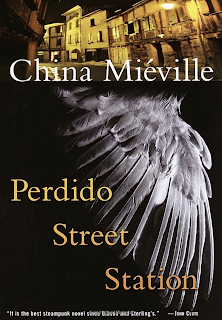
Essence Reviews: Perdido Street Station by China Miéville


Perdido Street Station by China Miéville is a steampunk novel that takes place in the world of New Crobuzon, which is beneath an ancient, dead beast’s towering ribs. When I stopped reading, Issac and Lin started their unique journeys. Issac is about to attempt to construct wings for a Garuda, a half-bird, half-human creature, named Yagharek, who has come to him for help from the Cymek. 

Lin and Issac’s relationship would be frowned upon in New Crobuzon if people knew about it. Issac is a human and Lin is a khepri. Khepri are not despised as they once were, but there are people and creatures alike who do have prejudices against khepri. Issac seems to be enamored with Lin for who she is, and he can be possessive. However, he does not want to be seen in public with her, and this is a source of contention for Lin, who is unashamed of who she is and what she does. She is proud of her rebellion, whereas Issac is quiet about his. He wants to keep it that way so he can continue to be in the “in-crowd.”

Lin, a self-exiled artist, has been commissioned to create an artwork for a creature only known to her as Mr. Motley. Mr. Motley found Lin through several drug suppliers and was highly impressed with her work. 


Perdido Street Station is populated by a diverse cast of people and creatures. Miéville has created an entire system in this novel and needs all the pages to tell the story. It is a good selection for fans of Charles Dickens, Neal Stephenson, and Franz Kafka, of whom this book is “reminiscent” (from the back cover flap). 

Essence Reviews: The Kill Room by Jeffery Deaver


What could you do with a “million-dollar bullet”? In Jeffery Deaver’s thriller/suspense novel The Kill Room, lead forensic investigators Lincoln Rhyme and Amelia Sachs attempt to answer just that question. 

In the Bahamas, an expatriate of the United States who was last seen in New York has been assassinated by a sniper. Bahamian authorities are reluctant to cooperate, having their tourist interests in mind. Shreve Metzger, head of National Intelligence and Operations Service (NIOS) is a vigilante whose office’s mission is to eliminate terrorists and anti-Americans. But a whistleblower who signed their note off with the name “A person with a conscience” from New York brings in the NYPD. Rhyme, Sachs, and NYPD officers must race against time as prime people who last saw or interacted with the deceased begin to disappear. 

As the crime story unfolds, a plot thread about perceived ability undercurrents. Rhyme is a quadriplegic and uses a motorized wheelchair. A minor but still significant point of the novel is that Rhyme is due to have surgery to give him use of his right hand. Throughout the book, we see another character deal with chronic pain that impacts their work in the field, and could result in them being permanently desked if they don’t take action soon. 

Reading this novel was out of my traditional wheelhouse. It was a fast-paced, edge-of-your-seat read, good through the final word. 
TAKE A BOOK ~ SHARE A BOOK
This book and many more can be found at The Little Free Library.

GET TO KNOW A CONTRIBUTOR: Essence B Scott


Essence B. Scott is an intern at Literacy Connections of Wayne County. Born and raised in Mercer County, New Jersey, she moved to Goldsboro, North Carolina from Gaston in February 2021. Essence is a writer with disabilities and has found creative writing helpful to process challenging times in her life. She has an Associates degree from Mercer County Community College and is eager to pursue a Bachelors degree in Social Work. 

Essence Reviews: Mad Dash by Patricia Gaffney


Patricia Gaffney’s novel Mad Dash is a novel whose message is “What is at the heart of all things?” That is the question the main characters, Andrew and Dash Bateman, have to answer. 

When Dash and Andrew find an abandoned dog on their doorstep, Dash is more than excited to keep it, love, and nurture it. Andrew, not so much. He is allergic to all dogs but his own: Hobbes, an ancient [insert breed here] that used to be his father’s. Dash is unhappy in her marriage to Andrew of twenty years. From the faculty parties at Mason-Dixon College that Andrew does not take part in, to Dash’s mother’s death, to their daughter, Chloe, going away to college, there have been little things that have been pecking at this marriage. 

But this seemingly dead dog is the last of many straws for Dash, who abruptly leaves and heads to the cabin in Virginia. Here, both Andrew and Dash begin to reevaluate what they mean to one another with the help of other characters. For Dash, these take the form of Greta, an eccentric new hire for Dash’s photography business; Maureen (“Mo”), Dash’s best friend who has sworn off monogamy after the dissolution of her marriage; the Benders, Shevlin and Cottie, who help maintain the cabin and surrounding land where Dash stays, and Owen Roby, a farmhand. For Andrew, these characters are Elizabeth O’Neal, an all-black wearing, feminist professor; Tim, a colleague and friend; and Wolfie, a neighborhood child. Together, along with a marriage counselor, Dr. Fogelman, these characters make Andrew and Dash, respectively, confront issues of partnership and what it means to work together.

When Andrew becomes very ill, the Batemans must make a decision: will they stay together and pull through, or will they come apart and ultimately get a divorce?

Told through alternating points of view with a strong cast of supporting characters, this novel is sure to please. 

TAKE A BOOK ~ SHARE A BOOK 
This book and many more can be found at The Little Free Library.


Featured Writer: Essence B. Scott                              (Literacy Connections Intern) Essence uses writing as a way to process her youth and adolescence, and wants to inspire others with disabilities to become self-sufficient, strong advocates for themselves and others. 

We Are The World

One of our lovely interns shared this beautiful rendition of "We Are The World" with us this week.  Take a few minutes today to listen to this iconic 1985 song performed by the very talented students of Clarksville Elementary School in Indiana. Enjoy! 


A Year Of Reading The World with Ann Morgan

SOURCE: https://www.ted.com/talks/ann_morgan_my_year_reading_a_book_from_every_country_in_the_world?referrer=playlist-talks_for_lifelong_readers#t-524597

ANN MORGAN set an ambitious goal: to read one book from every country in the world over the course of a year. Now she's urging other Anglophiles to read translated works so that publishers will work harder to bring foreign literary gems back to their shores.


FEATURED POST: The Freedom of Literacy by TRENÈE CHIMÈRE LURRY

SOURCE:https://www.literacyworldwide.org/blog/literacy-now/2021/08/05/the-freedom-of-literacy

ORIGINAL POST DATE: AUGUST 2021

This post comes to us from Trenèe Chimère Lurry, a special education teacher. 


Literacy opens the door and opportunity to freedom—to engage in a world separate from the one in which you reside. If you allow yourself to enter, your options are endless. Frederick Douglass said, “Once you learn to read, you will be forever free.” Literacy offers that opportunity. It opens a door to freedom that can be conceived only once it is obtained.

However, lacking in this ability connects to a prison of the mind, a prison that holds many of our Black and Brown children hostage, and a prison that can prevent all students from experiencing the joy that we know literacy can bring to their lives.

TEACHING TO DREAM

Finding the joy in literacy requires the ability to dream. We know our students come with many different needs and differences. But the ability to dream should be afforded to everyone regardless of skill level or ability. A dream is a cherished ambition, aspiration, or ideal.

As educators, we must believe for our students what they sometimes do not believe for themselves. Your dreams for your students’ achievements and expectations go hand in hand and can open the door for a reality that can supersede your greatest expectations. Having great aspirations for your students will increase their desire to reach them.

Research has proven that high expectations improve performance. What you believe about your students can be a motivating factor in or a deterrent to their progress. You may see scores you don’t like or a curriculum that does not support your aspirations for your students. But I urge you: Do not allow your eyes or your present reality to deter your dreams. Believe what can be. Help your students by allowing them the freedom to dream. Let the dreams that you have become the goals that you set. Communicate the dreams you have about your students to them so they know you believe. Make your dreams visible so students can see them. Display vision boards so students can connect with what you envision.

Help make dreams become reality. Push for necessary changes to curriculum. Do not let policies stifle the possibilities that are endless when dreams and high expectations collide.

TIME FOR CHANGE

I can speak confidently because of my special education background. I have seen students find their joy in literacy. For eight years, I was immersed in it. I taught high school life skills. My struggle daily was having to use a reading program that lacked both a focus on phonemic awareness and texts that were grade-level appropriate. Students’ reading levels were between first and fourth grade but their ages were 14–21.

Once my district found a program that concentrated on phonics, as well as grade-level culturally responsive texts with diverse representation and relevant topics, dreams became realities. I saw Lexile levels soar 30 to 50 points in three months. Confidence that I never saw before in the eyes of my students appeared, and I saw the doors of opportunity and possibility open, and areas of darkness become lightened.

Opportunities were on the horizon for my students. That same possibility can exist for more students if we just begin to shift the narrative and change our perspective. I never stopped dreaming no matter what my reality was. Because of that, I firmly believe that all students can walk in freedom and the joy of literacy.

POSTS TO ENJOY

Procrastibaking: In the Kitchen with Julie (in Partnership with Literacy Connections)

Enjoy our first Thanksgiving special celebrating Literacy Connections and all things cookbook! https://www.procrastibakingpodcast.com/podcas...